
“Coaching” as a term is not protected and is widely used in all aspects of life. All sorts of coachings are available online and offline, such as: life coaching, health coaching, career coaching etc. which makes the term and profession a bit difficult to grasp.
Looking at the context in which a coach is needed
Usually, people work with coaches, when they want to change a current state to a desired future state and didn’t (sustainably) succeed so far on their own.
So, coaching in many cases is very goal oriented, focusing on the desired end-state. “I want to have a six-pack”, “I want to eat healthy”, “I want to take better career decisions” etc. … not asking or questioning, why they want to achieve the goal in a first place.
When the goal is achieved, the coach is retired and the client often jumps back into old habits (yoyo effect) and ending up in the same situation as before.
So the question is: how can we achieve sustainable personal change?
Value oriented systemic coaching
In order to create change and maintain it, the “Coaching Akademie Schweiz” developed the “value oriented systemic coaching” in the 90’s. The key is, that a specific context is targeted, and a value is defined as a resource.
This brings the client closer to the desired state from the intellect (will-power) to the sub-conscious (habit).
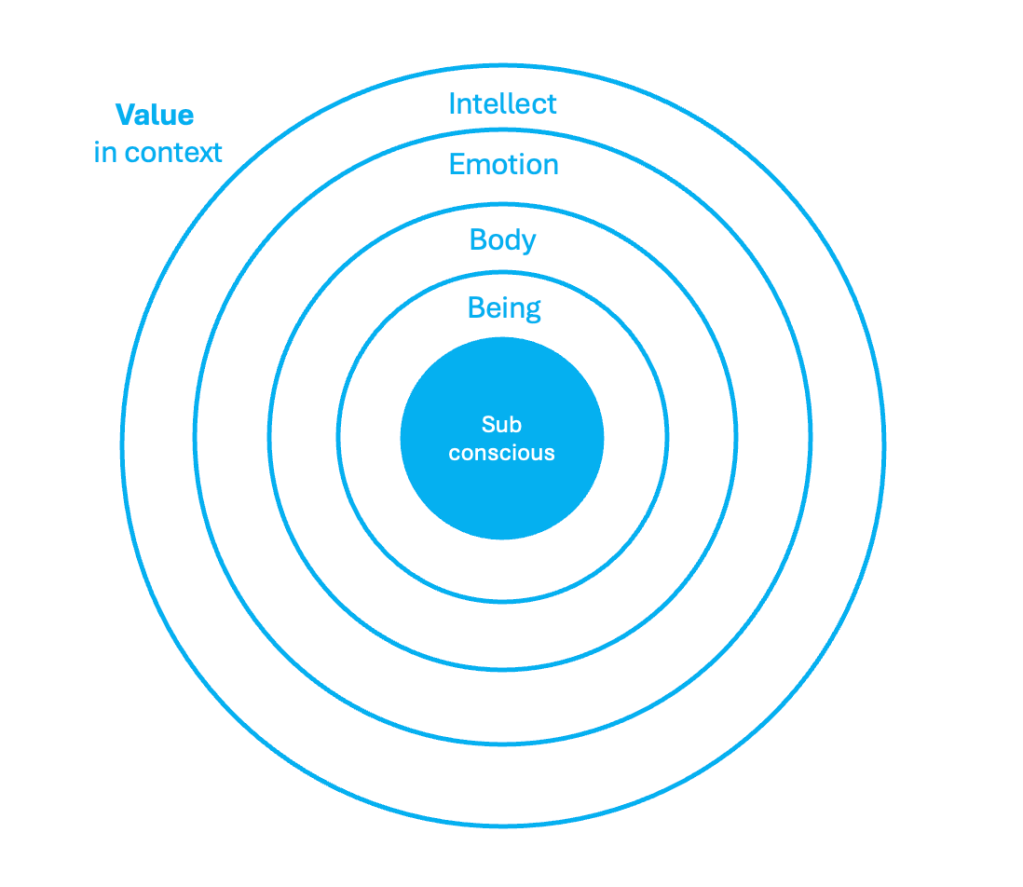
The neurological levels (R. Dilts) to make this change stick go from context & environment, to behavior, (…), through identity, to mission.
An example of the difference in levels is:
- Behavior: “I am not smoking”
- Identity: “I am a non-smoker”
This change in perspective brings as a result that the client sees himself as a non-smoker and behaves accordingly.

Please don’t confuse the process from behavior to identity (or anything in between) with simply wishful thinking (or positive thinking) – but an actual identification with the mental picture which creates lasting change.
If you want to read more (unfortunately in German) – please find more on the concepts here.
 postnovo
Leave a comment